
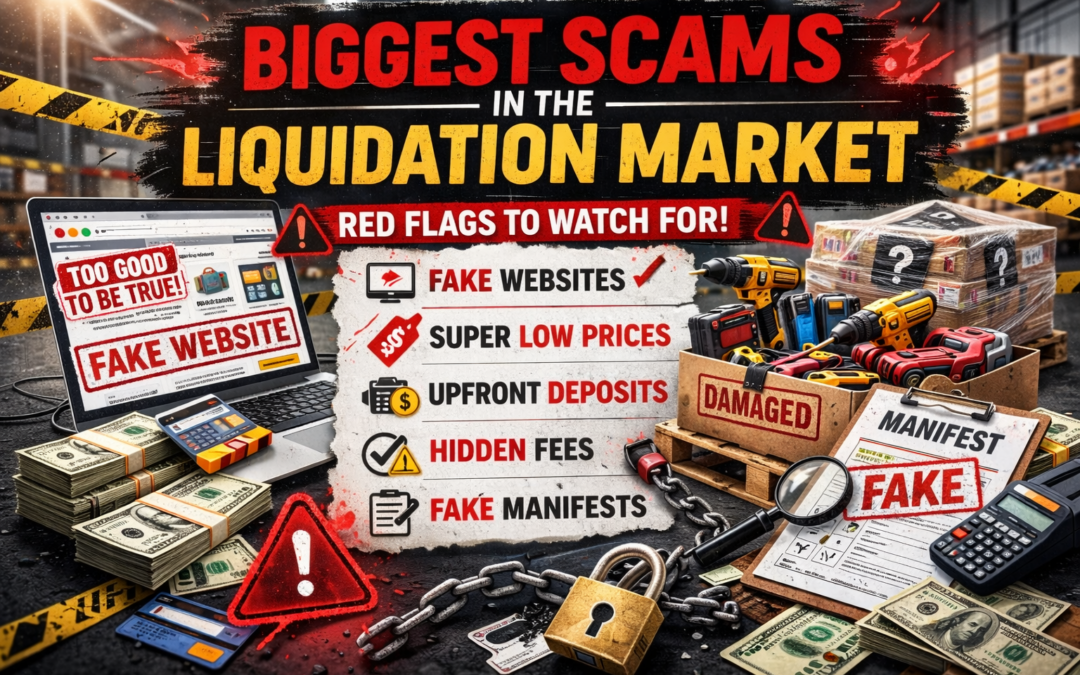
The Biggest Scams in the Liquidation Market (and how not to become the cautionary TikTok)
Liquidation attracts scammers for the same reason porch lights attract moths: lots of eager buyers, lots of “too-good-to-be-true” pricing, and enough jargon (“manifested,” “Amazon returns,” “truckload”) to make nonsense sound official.
Below are the biggest, most common scams—plus red flags and defenses you can actually use.
1) The “$29 Amazon Pallet” Social Media Ad Scam
How it works: You see a social media ad offering “Amazon returns pallets” for absurdly low prices. You pay, then either receive nothing or get a box of disappointment that has nothing to do with what you ordered.
Why it works: It hijacks your bargain-brain by borrowing credibility from major brands.
Red flags
-
Price that ignores basic economics (freight alone can cost more than the “pallet”)
-
New/empty website, vague “About” page, no real business footprint
-
Payment methods that reduce protections (wire/crypto/cash-app style pressure)
Defense
-
The FTC has warned about social media ads promising “super low prices” on well-known brands being scams:
https://consumer.ftc.gov/consumer-alerts/2025/08/social-media-ad-super-low-prices-well-known-brands-could-be-scam -
Malwarebytes has a practical breakdown of pallet liquidation scams and how the “big retailer name” trick works:
https://www.malwarebytes.com/blog/news/2024/12/pallet-liquidation-scams-and-how-to-recognize-them
2) Fake Liquidation Websites (Copycat storefronts)
How it works: Scammers spin up a site that looks like a liquidation company (warehouse photos, pallets, “testimonials,” fake “About” story). You pay and get ghosted—or you get strung along with “shipping updates” that never end.
Red flags
-
No verifiable address or phone (or the phone never answers)
-
Stock photos, stolen images, generic product pages
-
“Certified partner” claims with no proof
-
“Only today!” countdowns and high-pressure copy
Defense
-
Direct Liquidation (a legit operator) explains signs of fake liquidation sites and what to look for:
https://www.directliquidation.com/blog/post/spot-fake-liquidation-sites-avoid-scams
3) The “Extra Fee” Trap (Insurance / Release / Delivery Hold)
How it works: After you pay, they claim your pallet is “held” and you must pay an additional fee—often called insurance, refundable deposit, warehouse release, customs, re-delivery, etc. If you pay, there’s often another fee.
Why it’s nasty: It weaponizes sunk-cost fallacy. (“I already paid once… I can’t stop now.”)
Defense
-
This pattern shows up repeatedly in real consumer complaints/reviews. Example page (read critically, but it shows the recurring “extra fee” story):
https://www.trustpilot.com/review/liquidationpalletsforsale.com
4) “Amazon/Walmart/Home Depot Partner” Impersonation
How it works: They claim they’re an “official partner,” “authorized distributor,” or “direct from Amazon warehouse,” but they’re just name-dropping to borrow legitimacy.
Red flags
-
Big-brand claims with zero verifiable relationship
-
Fake certificates/badges (“verified supplier,” “official returns program”)
-
No independent footprint beyond their own website/social pages
Defense
-
BBB Scam Tracker reports are often useful for identifying common patterns and specific scam domains being reported:
https://www.bbb.org/scamtracker/lookupscam/1089396
https://www.bbb.org/scamtracker/lookupscam/1040224
5) The “Manifest Mirage” (Inflated MSRP + Cherry-Picked Lists)
How it works: The seller provides a manifest that looks amazing—big MSRP totals, known brands, “high value”—but it’s padded, outdated, or not tied to the actual pallet. Sometimes it’s literally labeled “example” but presented like it’s your lot.
Common tricks
-
MSRP totals instead of real resale comps
-
“Manifested” lots that aren’t actually accurate
-
The “good items” are a tiny fraction; the rest is filler
Defense
-
Always comp-check a sample of SKUs (sold comps, not asking prices).
-
Assume a haircut for returns/salvage conditions even if the manifest looks great.
-
If a seller won’t clarify whether the manifest is for that exact lot, treat it as a flashing red light.
6) “Local Warehouse” Social Proof Scams (Marketplace + Burner Profiles)
How it works: A local-looking Facebook Marketplace seller offers pallets with warehouse photos and urgency. They push for a deposit and avoid letting you verify inventory.
Red flags
-
New profile, weak history, inconsistent details
-
Won’t allow pickup or inspection
-
Pushes deposits “to hold it” but dodges proof
Defense
-
Never send a deposit unless you can verify:
-
the address is real and matches a warehouse footprint
-
a live walkthrough video of the exact pallet(s)
-
consistent business presence outside marketplace messages
-
7) “Business Opportunity” Scams (Done-for-you store + guaranteed profits)
How it works: This isn’t always “liquidation” directly, but it preys on liquidation-curious buyers: “We’ll set up your store, source pallets, and guarantee profits.”
Defense
-
The FTC has taken action against e-commerce business opportunity scams built around inflated earnings claims:
https://www.ftc.gov/news-events/news/press-releases/2025/07/ftc-action-against-e-commerce-business-opportunity-scam-results-permanent-bans-owner-his-companies
A simple anti-scam ruleset (works shockingly well)
Rule 1: If the deal ignores freight economics, it’s fake.
Pallets are heavy. Shipping costs money in this universe.
Rule 2: If they steer you away from protected payments, walk.
Scammers love irreversible payments.
Rule 3: Verify the seller outside their own website.
Look for independent footprint and complaint patterns:
-
FTC consumer guidance: https://consumer.ftc.gov/consumer-alerts/2025/08/social-media-ad-super-low-prices-well-known-brands-could-be-scam
-
BBB Scam Tracker examples: https://www.bbb.org/scamtracker/lookupscam/1089396
-
Malwarebytes scam breakdown: https://www.malwarebytes.com/blog/news/2024/12/pallet-liquidation-scams-and-how-to-recognize-them
Rule 4: Urgency is a weapon.
“Act now” usually means “think less.”
Quick safer-buy checklist (copy/paste friendly)
-
Use a payment method with dispute protection (when possible)
-
Confirm a real address + real contact method
-
Get freight terms in writing before you pay
-
If there’s a manifest, comp-check a sample of items
-
Start small; scale only after repeat successful deliveries
Sources / Official Links (copy/paste)
https://consumer.ftc.gov/consumer-alerts/2025/08/social-media-ad-super-low-prices-well-known-brands-could-be-scam
https://www.malwarebytes.com/blog/news/2024/12/pallet-liquidation-scams-and-how-to-recognize-them
https://www.directliquidation.com/blog/post/spot-fake-liquidation-sites-avoid-scams
https://www.bbb.org/scamtracker/lookupscam/1089396
https://www.bbb.org/scamtracker/lookupscam/1040224
https://www.trustpilot.com/review/liquidationpalletsforsale.com
https://www.ftc.gov/news-events/news/press-releases/2025/07/ftc-action-against-e-commerce-business-opportunity-scam-results-permanent-bans-owner-his-companies