
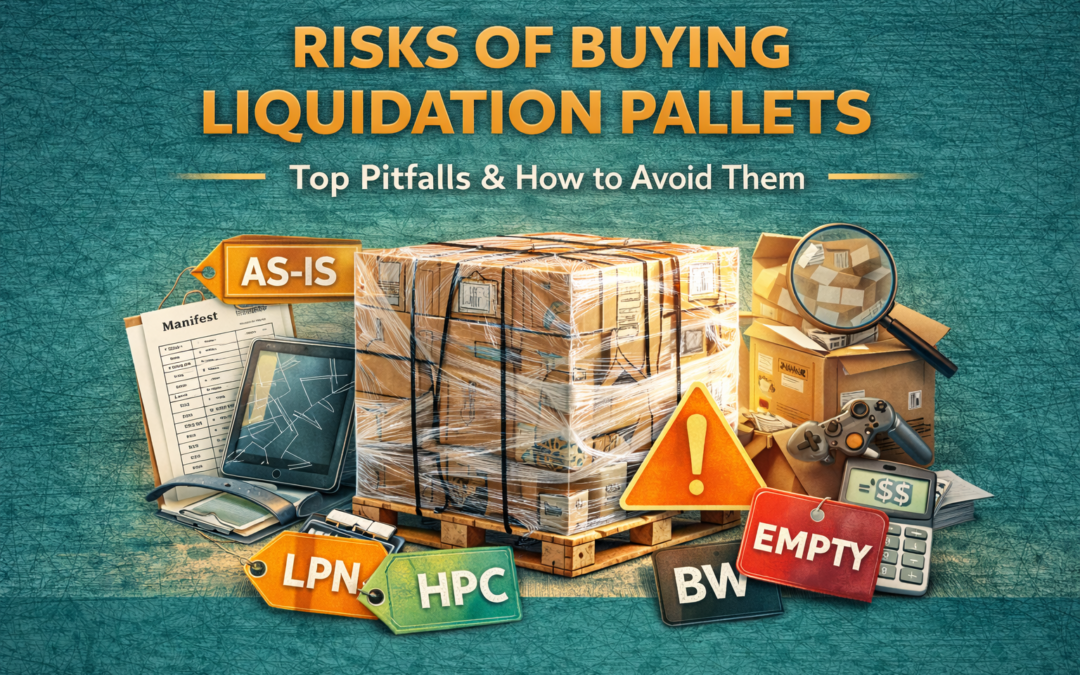
The Biggest Risks When Buying Liquidation Pallets (And How to Avoid Getting Smoked)
Liquidation pallets can be a cheat code for inventory… or a fast way to convert money into a garage full of “why.” The risk isn’t that liquidation is automatically a scam. The risk is that it’s a probability business—and beginners often price it like retail.
Below are the greatest risks in purchasing liquidation pallets, how they show up, and how to reduce them without killing your margins.
1) Condition uncertainty (the “as-is” reality)
Many pallets are sold as-is, often containing a mix of new, open-box, used, incomplete, or non-working items. Return streams are especially variable because customers return for every reason imaginable—defect, missing parts, changed mind, used once, “my cat didn’t like it,” etc.
How it burns you: you assume “returned” means “basically new,” and your profit collapses under missing parts, damage, and testing time.
How to reduce it:
-
Prefer graded lots (A/B/C, tested/untested) when you’re learning.
Direct Liquidation’s condition explanations are a good example of how platforms define grades and “untested returns”:
https://www.directliquidation.com/how-it-works/merchandise-conditions-explained/ -
Use marketplaces that clearly describe condition types and inventory categories:
B-Stock inventory types/conditions overview:
https://bstock.com/blog/getting-started-inventory-types-conditions/ -
Buy categories you can test quickly (small appliances, tools you know).
-
Price pallets assuming a meaningful percentage is unsellable.
2) “Manifest illusion” (lists aren’t promises)
A manifest can help, but it can also be wrong, incomplete, or based on upstream scans rather than physical verification. Items can be substituted, missing, misidentified, or listed at inflated MSRP.
How it burns you: you buy the spreadsheet, not the pallet.
How to reduce it:
-
Treat manifests as probabilities, not guarantees.
-
Check a sample of items for real-world resale value (sold comps), not MSRP.
-
Learn how the platform expects you to use manifests:
B-Stock “All About Manifests”:
https://bstock.com/blog/buying-basics-all-about-manifests/ -
If you’re buying customer returns, it’s worth reading how marketplaces describe condition sections and manifest expectations:
https://bstock.com/blog/a-guide-to-buying-customer-returns/
3) High piece count = high labor (sorting is the silent killer)
HPC pallets look great because the cost per item is low. But if you have to sort, test, clean, photograph, list, and store 200+ small items, your time becomes the most expensive part of the deal.
How it burns you: you “profit” on paper but lose in labor.
How to reduce it:
-
Know your channel: HPC is great for bin stores and bulk sellers, not always for Marketplace one-offs.
-
Set a time budget: if you can’t process it quickly, don’t buy it.
-
Start with pallets that have bigger average item value and fewer total pieces.
-
Use a pre-buy checklist to force discipline (helpful even if you don’t use B-Stock):
https://bstock.com/blog/the-complete-checklist-for-buying-liquidation-pallets/
4) Missing parts and accessories (death by a thousand $8 adapters)
A pallet can be full of perfectly good products that are missing:
-
remotes
-
shelves
-
hoses
-
chargers
-
proprietary cables
-
manuals/mounts/hardware
How it burns you: every missing part becomes a “mini project,” and mini projects breed chaos.
How to reduce it:
-
Prioritize categories with universal replacements (standard cords, common chargers).
-
Avoid categories with proprietary accessories until you have sourcing pipelines.
-
Keep a “parts salvage box” and build a small replacement inventory over time.
5) Electronics testing risk (and the “it powers on” trap)
Electronics are tempting because of high retail prices. But “powers on” is not the same as “works,” and returns can hide:
-
intermittent failures
-
locked accounts
-
missing firmware
-
dead batteries
-
expensive-to-source components
How it burns you: you end up with a pile of “almost” devices that don’t resell well.
How to reduce it:
-
Only buy electronics pallets if you have a test bench (basic cables, chargers, screens, etc.).
-
Choose items with easy functional tests (routers, monitors, vacuums).
-
Price electronics like they’re guilty until proven innocent.
-
For how some liquidation sellers categorize returns/refurbished/tested-not-working (useful for learning the language):
https://www.directliquidation.com/blog/post/the-different-categories-of-wholesale-electronics-untested-customer-returns-refurbished-reconditioned-and-tested-not-working-a-breakdown-of-whats-what/
6) Category mismatch (buying stuff your market doesn’t want)
A pallet can be “good inventory” and still be a bad buy if your buyers aren’t there. Example: a pallet heavy in niche phone cases might be fine on Amazon FBA… but slow locally.
How it burns you: you’re stuck holding inventory that moves too slowly.
How to reduce it:
-
Buy pallets that fit your channels (local pickup vs shipping).
-
Track what actually sells in your market (Grand Rapids buyers love practical household and appliances).
-
Focus on repeatable categories, not novelty.
7) Shipping, freight damage, and delivery surprises
If you ship pallets LTL freight, you’re exposed to:
-
damage in transit
-
delivery appointments and access issues
-
liftgate costs
-
residential delivery fees
-
claims processes that take time
How it burns you: you pay more than expected or receive damaged goods that were profitable before the forklift got involved.
How to reduce it:
-
Start with local pickup while learning.
-
Confirm freight fees up front (liftgate, appointment, limited access).
-
Inspect at delivery and document everything immediately.
-
Practical guidance on noting damages/shortages on delivery paperwork:
https://www.echo.com/resources/blog/how-notate-damages-and-shortages-bill-lading-and-proof-delivery/ -
If you want the “rule language” vibe for claims windows and filing limits, the NMFTA Uniform Bill of Lading Terms & Conditions PDF is useful reference material:
https://nmfta.org/wp-content/media/2022/10/Uniform_Bill_of_Lading_Terms_and_Conditions.pdf
8) Returns fraud and “empty box” problems
Yes, it happens: customers return the wrong item, a swapped item, or an empty box. Some retailers catch it; sometimes it slips through into liquidation streams.
How it burns you: you can’t resell “a box that once knew a blender.”
How to reduce it:
-
Expect some fraud loss in your pricing model.
-
Avoid high-fraud categories early (certain consumer electronics).
-
Choose sellers who do better inbound checks and/or offer clear condition grading.
9) Policy risk: no returns, short pickup windows, strict rules
Many liquidation sellers operate on tight windows:
-
short pickup timelines
-
storage fees
-
“no refund” terms
-
strict dispute rules
How it burns you: you miss pickup, get charged, or can’t dispute missing/damaged items.
How to reduce it:
-
Read terms like you’re signing a lease (because financially, you are).
-
Only bid/buy when you can meet pickup and cleanout requirements.
-
Prefer sellers with clear policies and transparent grading (condition pages help—see Direct Liquidation conditions above).
10) Cashflow risk (inventory eats money quietly)
Buying pallets ties up cash in:
-
inventory sitting unsold
-
storage space
-
labor time
-
supplies (totes, shelves, bags, labels)
-
dumps and disposal costs
How it burns you: you “have inventory” but can’t pay bills.
How to reduce it:
-
Keep first buys small and fast-moving.
-
Don’t reinvest 100% of cash until you understand sell-through rate.
-
Set a rule: “If it doesn’t move in X days, we markdown or bundle.”
A simple “risk score” you can use before buying
Rate each from 1 (low risk) to 5 (high risk):
-
Condition uncertainty
-
Missing parts likelihood
-
Testing complexity
-
Labor/sorting workload
-
Sell-through speed in your market
If your total is 18+, it’s probably a “learn an expensive lesson” pallet.
The healthiest mindset: you’re buying probability, not products
Liquidation pallets aren’t retail. You’re buying a distribution of outcomes:
-
some wins
-
some okay items
-
some junk
-
some time sinks
Your profit comes from:
-
buying the probability at the right price
-
processing efficiently
-
selling through fast
When those line up, liquidation feels like magic. When they don’t, it feels like you adopted 200 broken toasters.
Sources / Official Links (copy/paste)
Manifests / buying basics
https://bstock.com/blog/buying-basics-all-about-manifests/
https://bstock.com/blog/the-complete-checklist-for-buying-liquidation-pallets/
https://bstock.com/blog/a-guide-to-buying-customer-returns/
https://bstock.com/blog/getting-started-inventory-types-conditions/
Condition grading examples
https://www.directliquidation.com/how-it-works/merchandise-conditions-explained/
https://www.directliquidation.com/blog/post/the-different-categories-of-wholesale-electronics-untested-customer-returns-refurbished-reconditioned-and-tested-not-working-a-breakdown-of-whats-what/
Freight / delivery documentation
https://www.echo.com/resources/blog/how-notate-damages-and-shortages-bill-lading-and-proof-delivery/
https://nmfta.org/wp-content/media/2022/10/Uniform_Bill_of_Lading_Terms_and_Conditions.pdf