
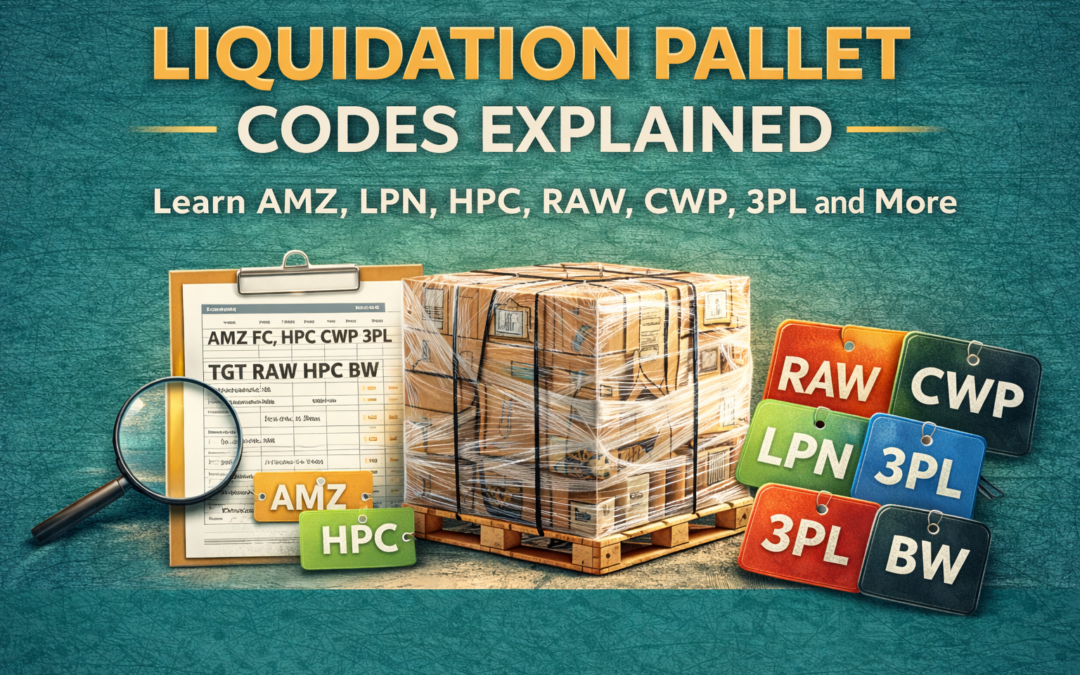
Liquidation Pallet Codes Explained: A Beginner-Friendly Guide to Abbreviations (AMZ, HPC, LPN, 3PL, CWP + More)
If you’ve ever looked at a liquidation listing that reads like “AMZ HPC LPN RAW CWP 3PL” and thought, “I am one acronym away from joining a monastery,” you’re not alone.
Liquidation warehouses use short codes to describe where inventory came from, how it was handled, how it’s packaged, and how it ships. The catch: there’s no single universal standard. One seller’s codes can mean something slightly different at the next warehouse (or even evolve over time at the same warehouse).
So the goal isn’t to memorize a “perfect dictionary.” The goal is to learn the pattern behind the codes so you can decode listings quickly and buy smarter.
Why pallet codes vary by warehouse (and why that’s normal)
Most codes come from one of three places:
-
Retailer / program labeling (especially Amazon streams like LPN and ASIN)
-
Liquidator’s internal sorting/packaging system (RAW vs processed, wrap types, “monster pallet,” etc.)
-
Freight and wholesale vocabulary (3PL, FOB, BOL, LTL, case pack, gaylord)
Warehouses also sell different “levels” of product:
-
some sell untouched / RAW inventory
-
some pre-sort into case packs or category lots
-
some specialize in HPC mixed pallets
Pro rule: Always look for the seller’s own abbreviation key or FAQ first. If they publish one, treat that as the authority for their listings.
How to decode a liquidation code string in 20 seconds
Most listings are a mashup of these buckets:
-
Source / retailer (AMZ, WMRT, TGT, etc.)
-
Program / identifier (LPN, ASIN, FC, etc.)
-
Handling level (RAW vs processed/graded)
-
Lot format (HPC, case pack, gaylord, stacked)
-
Packaging / wrap (CWP, BW, etc.)
-
Logistics (3PL, FOB, LTL, BOL)
Example: “AMZ HPC LPN RAW CWP 3PL”
Read it like:
Amazon stream → return label identifier → many small pieces → unprocessed → clear wrap → handled/moved via a third-party logistics provider.
The most common liquidation pallet abbreviations (high-coverage cheat sheet)
1) Retailer / source codes (very common)
These are widely used shorthand by warehouses and resellers. They’re not always “official,” but they’re common:
-
AMZ = Amazon
-
WMRT = Walmart
-
TGT = Target
-
DG = Dollar General
You’ll also see variations like “AZ” (Amazon) depending on the seller.
2) Amazon / program identifiers (common in returns pallets)
LPN = “License Plate Number” label (often seen on Amazon returns)
This is a unique tracking label you often find on returned items in Amazon’s ecosystem. Amazon Seller Central forum staff explicitly describes LPN as “license plate number” used to track items through fulfillment and returns.
https://sellercentral.amazon.com/seller-forums/discussions/t/5d5e61e3-2a21-46d4-b009-63dfb19874e5
Reality check: Seeing an LPN label usually suggests the item moved through a returns/warehouse process—but it doesn’t automatically tell you the condition is good or bad.
ASIN = Amazon Standard Identification Number
ASIN is Amazon’s product identifier for catalog listings (you’ll see it in manifests, research, and sometimes reseller chatter). Amazon’s own seller education explains ASIN and how it functions.
https://sell.amazon.com/blog/what-is-an-asin
FC = Fulfillment Center (warehouse stream shorthand)
“FC” commonly gets used to mean fulfillment center stream, but what it specifically implies depends on the seller’s internal labeling.
3) Handling / processing level (how “touched” the goods are)
RAW = Unprocessed by the distributor/liquidator
RAW typically means you’re getting inventory closer to how it arrived—more variance, more labor, more upside, more “why is this sticky?”
Translation: RAW = higher uncertainty + higher workload, sometimes lower buy-in.
4) Lot format / workload signals
HPC = High Piece Count
Many small items, heavier sorting workload.
Translation: cheaper per unit can be true… but your labor is the real price tag.
Case Pack / Case Lot = consistent units per case
A “case pack” is a standard quantity of identical units packed in a single case/carton (used by warehouses and distributors).
https://www.econocorp.com/blog/what-is-case-pack-quantity
Translation: case packs are usually more predictable and faster to list than mixed pallets.
Gaylord = large corrugated pallet box for bulk loose items
Gaylord containers (also called pallet boxes) are large corrugated containers for shipping/storing bulk goods.
https://solusgrp.com/blog/post/what-s-the-difference-between-a-gaylord-container-and-a-pallet-box.html
Another clear definition with examples:
https://reusabletranspack.com/2024/01/what-is-a-gaylord-box/
Translation: gaylord lots often mean “bulk loose items,” so expect more sorting and condition variance.
Skid = another word for pallet
Often used interchangeably with pallet (sometimes regionally).
Double Stacked = one pallet stacked on another
A logistics detail that impacts handling risk and freight footprint.
5) Wrap / packaging (what you can see vs what’s hidden)
CWP = Clear Wrap (often “clear stretch wrap”)
Clear wrap usually means you can visually inspect more of the contents. Some sellers add “premium” language to clear wrap—don’t assume that equals quality unless that seller explicitly says so.
BW = Black Wrap
Black wrap reduces visibility and increases the “mystery factor.” Some warehouses use it as a tier marker, but it’s not universal.
Translation: wrap color usually signals visibility, not guaranteed value.
6) Logistics / freight terms (important for your real cost)
3PL = Third-Party Logistics
A 3PL is a company that handles or arranges logistics functions (warehousing, transport, fulfillment, etc.) for other businesses.
https://www.inboundlogistics.com/articles/3pl/
Another beginner-friendly definition:
https://rxo.com/resources/shipper/what-is-a-3pl/
FOB = “Free on Board” (shipping responsibility point)
FOB is a shipping term used to describe when responsibility/risk transfers (how it’s used can vary in practice—especially outside strict Incoterms usage).
https://www.freightquote.com/blog/what-does-fob-mean-in-freight-shipping/
Helpful nuance on “freight on board” wording vs official definitions:
https://www.plslogistics.com/blog/what-does-fob-mean-in-freight-shipping/
BOL = Bill of Lading
A Bill of Lading is a shipping document used in freight—commonly tied to LTL shipments and delivery paperwork.
FedEx freight explainer: https://www.fedex.com/en-us/shipping/freight/resources/bill-of-lading.html
NMFTA definition (contract/receipt/title functions): https://nmfta.org/what-is-a-bill-of-lading/
LTL = Less-Than-Truckload shipping
LTL is freight shipping where your pallet(s) take only part of a trailer rather than the whole thing.
FedEx LTL explainer: https://www.fedex.com/en-us/customer-support/faqs/business/freight-shipping/what-is-ltl-freight-shipping.html
XPO overview: https://www.xpo.com/resource-center/ltl/what-is-less-than-truckload/
“Reseller-world” abbreviations you’ll see near liquidation (condition + selling language)
Not every warehouse uses these on pallet tags, but you’ll see them constantly in descriptions:
-
BNIB / NIB = Brand New In Box / New In Box
-
OB = Open Box
-
BNWT / NWOT = Brand New With Tags / New Without Tags (apparel)
-
HBA = Health & Beauty Aids
-
B2B / B2C = Business-to-business / business-to-consumer
These matter because liquidation pallets often contain mixed conditions—and your channel (FB Marketplace vs eBay vs bin store) changes what “good” looks like.
Manifested vs unmanifested (why codes won’t save you)
A lot of buyers assume codes equal certainty. They don’t.
-
Manifested loads include a list of expected contents. Helpful, but imperfect.
-
Unmanifested / mystery loads have no detailed list and usually higher variance.
Codes help you estimate risk + workload, not guarantee value.
Quick translation examples (steal these for your buying notes)
Example 1: “TGT RAW HPC BW”
Target source → unprocessed → high sorting workload → black wrap (less visibility)
Translation: lower cost per item, higher labor, higher uncertainty.
Example 2: “AMZ LPN HPC CWP”
Amazon returns stream (LPN) → many small items → clear wrap
Translation: good for volume sellers/bin stores; expect missing parts + mixed condition.
Example 3: “WMRT Case Pack”
Walmart source → case-packed lots with consistent counts
Translation: less chaos, often higher buy-in, smoother listing workflow.
Buying tip: build your own “house key” for your favorite warehouses
Because codes vary, the best move is to create a warehouse-specific decoder for the sellers you use most:
-
Screenshot 10–20 listings you trust
-
Write down code strings + what you actually received
-
Mark patterns: which codes correlate with missing parts, more new items, more junk, etc.
In other words: turn their codes into your decision system.
Sources / Official Links (copy/paste)
Amazon identifiers
https://sellercentral.amazon.com/seller-forums/discussions/t/5d5e61e3-2a21-46d4-b009-63dfb19874e5
https://sell.amazon.com/blog/what-is-an-asin
Logistics / freight
https://www.inboundlogistics.com/articles/3pl/
https://rxo.com/resources/shipper/what-is-a-3pl/
https://www.freightquote.com/blog/what-does-fob-mean-in-freight-shipping/
https://www.plslogistics.com/blog/what-does-fob-mean-in-freight-shipping/
https://www.fedex.com/en-us/shipping/freight/resources/bill-of-lading.html
https://nmfta.org/what-is-a-bill-of-lading/
https://www.fedex.com/en-us/customer-support/faqs/business/freight-shipping/what-is-ltl-freight-shipping.html
https://www.xpo.com/resource-center/ltl/what-is-less-than-truckload/
Packaging / warehouse terms
https://solusgrp.com/blog/post/what-s-the-difference-between-a-gaylord-container-and-a-pallet-box.html
https://reusabletranspack.com/2024/01/what-is-a-gaylord-box/
https://www.econocorp.com/blog/what-is-case-pack-quantity